Today I found a great article about some specific type of question answering.
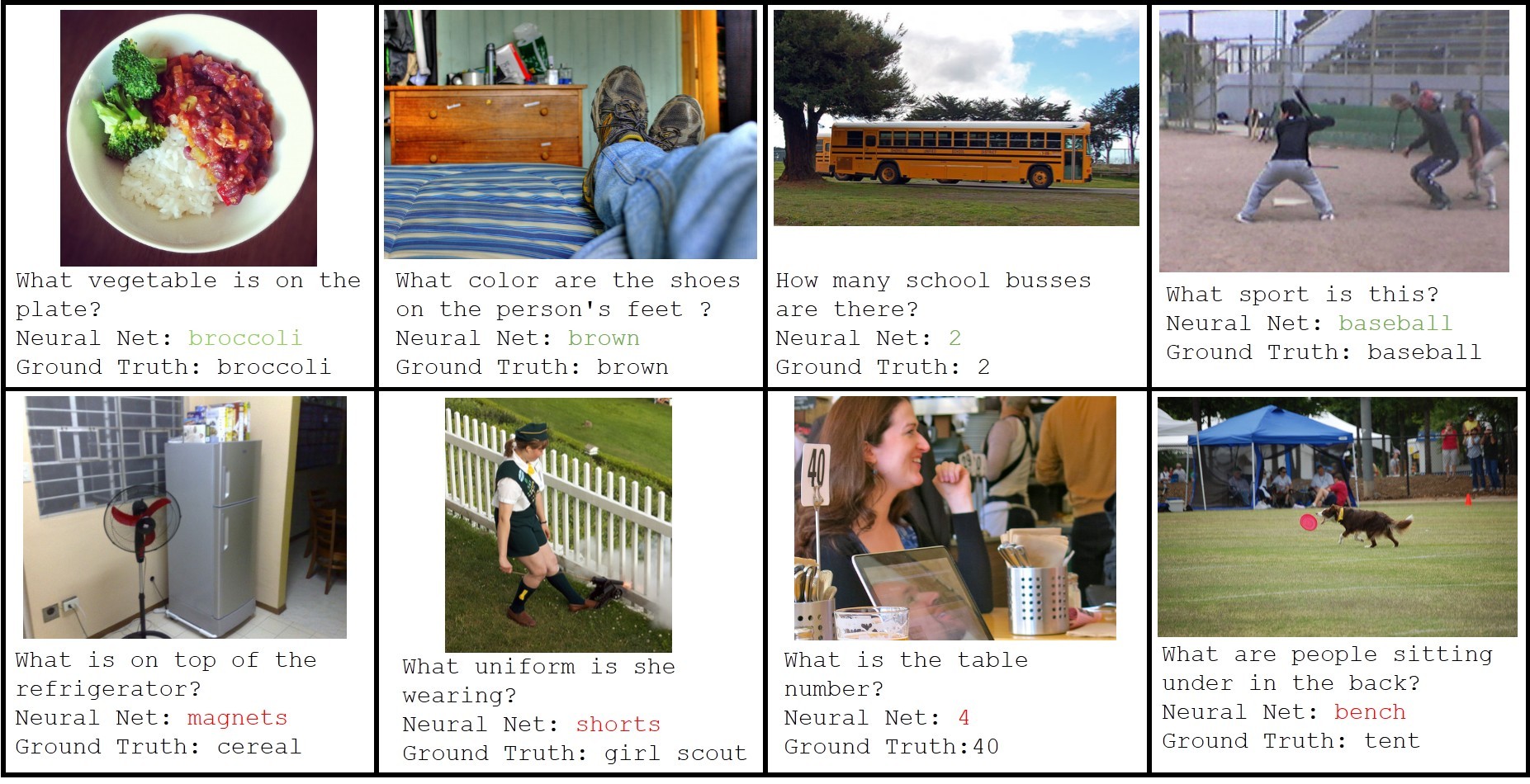
A picture worth a thousand words:
[picture from the original article]
It is not a big surprise - technically it as all about LSTM.
Enjoy reading: http://avisingh599.github.io/deeplearning/visual-qa/
Showing posts with label deep learning. Show all posts
Friday, May 6, 2016
Friday, April 17, 2015
Words similarity
Finding words (sentences, documents) with the same meaning is general problem for NLP (Natural Language Processing). Deep learning helps improve this field of science.
For example, word2vec approach helps you derive from text corpus some things with relationship like "man to king" as "women to ?". And "?" should be replaced by "queen". It's amazing stuff. In addition, you can train not just similarity word-to-word but also word-to-sequence of words.
Here is some examples from model which were trained on Google News corpus:
Paper with description:
Distributed Representations of Words and Phrases and their Compositionality"
Open-source implemenatation.
https://code.google.com/p/word2vec/
For example, word2vec approach helps you derive from text corpus some things with relationship like "man to king" as "women to ?". And "?" should be replaced by "queen". It's amazing stuff. In addition, you can train not just similarity word-to-word but also word-to-sequence of words.
Here is some examples from model which were trained on Google News corpus:
Paper with description:
Distributed Representations of Words and Phrases and their Compositionality"
Open-source implemenatation.
https://code.google.com/p/word2vec/
Tuesday, April 7, 2015
Deep Learning for Natural Language Processing
Videos, slides and tutorials fopm Stanford university course
CS224d: Deep Learning for Natural Language Processing can be found here: http://cs224d.stanford.edu/syllabus.html.
Friday, January 9, 2015
Dive into Deep Learning
If you are interested in deep learning - you can try UFLDL (Unsupervised Feature Learning and Deep Learning) tutorial from Stanford University.
If this topic is really new for you - it is better to start from https://www.coursera.org/course/ml. After this session course will change format into self-study.
Subscribe to:
Posts (Atom)


